Discover how Visus used Microsoft Azure AI services to turn complex product documentation into a conversational AI assistant that delivers answers grounded in trusted company data. Learn how Retrieval-Augmented Generation (RAG), intelligent document processing, and AI-powered search helped a manufacturing client successfully answer all 20 defined product compatibility test scenarios.
Making Product Knowledge Easier to Access
For manufacturers with extensive product catalogs, helping customers find accurate product information can be challenging. Compatibility guides, product specifications, and technical documentation often contain the answers customers need, but finding the right information can require searching through multiple documents.
Visus helped a manufacturing client explore a more accessible way to deliver this information through a conversational AI assistant powered by Microsoft Azure AI services. The solution allows customers to ask product-related questions in natural language and receive answers grounded in the company's own documentation.
Challenge: Finding the Right Information Across Multiple Documents
The client manufactures professional lighting products for law enforcement, military, industrial, and consumer markets. Its extensive product catalog includes detailed compatibility guides and product information sheets that help customers determine which products and accessories work with specific equipment.
Although the necessary information already existed, customers had to navigate multiple PDF documents to find the answers they needed. This process made product research more difficult and created an opportunity to improve the customer experience.
The challenge extended beyond making documents searchable. Product compatibility requires precise information, and an incorrect answer could lead customers to select incompatible products or accessories. A conventional chatbot relying primarily on a language model's general knowledge would not provide the level of control this use case required.
The solution needed to retrieve relevant information from the client's documentation, use that information to generate answers, and support follow-up questions without losing sight of the underlying product data.
Strategy: Building a Documentation-Grounded AI Assistant
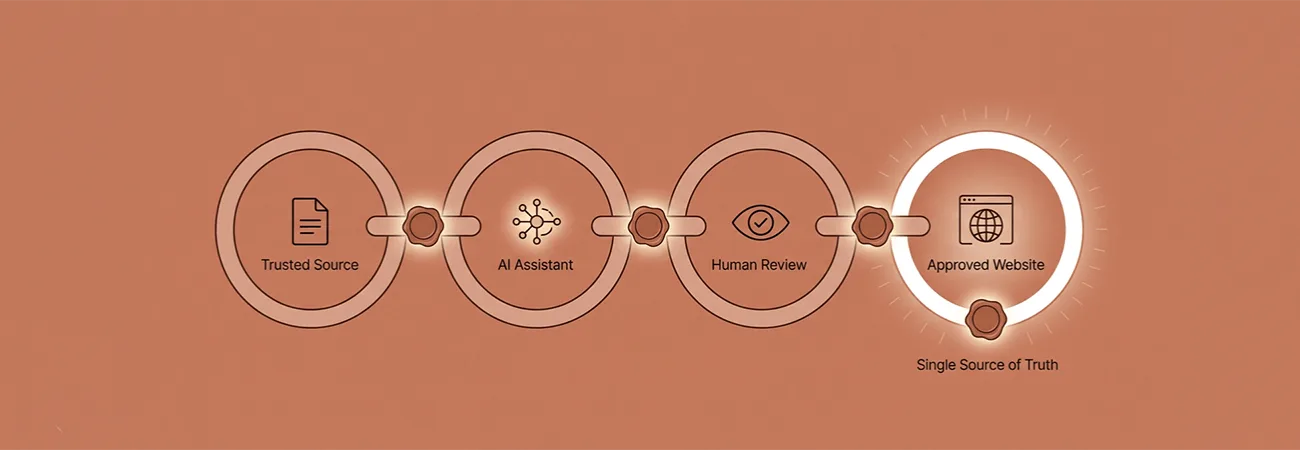
Visus designed a Retrieval-Augmented Generation (RAG) solution using Microsoft Azure AI services. This approach combines the conversational capabilities of an AI model with a search process that retrieves relevant information from trusted company documents before generating a response.
The project began with an ingestion pipeline to process the client's existing compatibility guides and product information PDFs. Using Azure Content Understanding, Visus extracted and normalized information from documents with different formats and structures, preparing the content for more consistent retrieval.
Visus then implemented Azure AI Search indexes to organize compatibility and product information. An AI assistant powered by an Azure OpenAI model uses these search indexes to retrieve relevant documentation for each customer question before generating an answer.
The architecture also supports multi-turn conversations. When a customer asks a follow-up question, the assistant performs a fresh search against the product documentation rather than relying solely on information from earlier messages. This helps keep responses connected to the source material as the conversation develops.
To evaluate the solution, Visus developed automated test scenarios covering common product compatibility questions. These tests provided a structured way to assess whether the assistant could retrieve the appropriate information and answer the questions accurately.
The architecture separates document ingestion from the customer-facing assistant. This design allows the client to incorporate new or updated product documentation without redesigning the entire AI experience.
Results: Validating Product Compatibility Answers
During testing, the updated solution successfully answered all 20 defined compatibility test scenarios.
The proof of concept demonstrated how a conversational AI assistant could make company-specific product knowledge easier to access while grounding its answers in the client's existing documentation.
The project also established a foundation for expanding the assistant's knowledge base. As the client adds more product information sheets and technical documentation, the architecture provides a structured approach to processing, indexing, and retrieving that information.
While the test results represent a defined set of scenarios rather than a guarantee of accuracy for every possible question, they demonstrate the potential of documentation-grounded AI for product support.
Turning Existing Documentation Into a More Accessible Resource
Organizations do not always need to replace their existing information systems or documentation to introduce AI. In many cases, the information they already maintain provides the foundation for more intelligent customer experiences.
The key is making that information accessible, structured, and retrievable in a way that supports reliable answers. For specialized use cases such as product compatibility, the quality of document processing and retrieval plays a critical role in the usefulness of the resulting AI assistant.
By combining Microsoft Azure AI services with a structured retrieval architecture, Visus helped the client demonstrate how existing product documentation could power a more conversational approach to customer support.
The broader lesson is that successful enterprise AI depends on more than the language model alone. Organizations must also build the right foundation around their data, ensuring that AI-generated answers remain connected to the information customers and employees can trust.