Learn how to make AI-powered personalization practical, privacy-conscious, and easy for marketing teams to manage. Discover how approved content variations, transparent rules, and existing performance metrics can create more relevant visitor experiences without adding unnecessary tracking or sacrificing editorial control.
Most personalization discussions start with visitor tracking and end with a conversation about privacy notices. Marketing teams that already struggle to keep their public pages accurate are rarely enthusiastic about a system that shows different versions of the same page to different people, especially when they cannot see what any given visitor received. The practical path is narrower. It uses signals the organization already collects, keeps the variations inside editorial control, and does not require a new tracking stack.
Intent and segment, not individual identity
The versions we build are based on the page the visitor is already on, the referral source if it is known, the device type, and, when the visitor is authenticated, the role or program they belong to. A clinic site can show a different next step to someone who arrived from a search for "new patient" than to someone who arrived from a staff portal link. A membership organization can show renewal language to an authenticated member and join language to an anonymous visitor. These are coarse segments. They do not require storing a profile of every click.
We do not build systems that remember a visitor's earlier questions across sessions in order to rewrite the homepage. That kind of memory creates two problems at once. It needs a consent mechanism the organization may not have, and it produces page variants that no one on the content team can review in advance. If the goal is to help a visitor complete a task they have already started, the current page and the current session are usually enough.
Editorial control stays with the people who own the pages
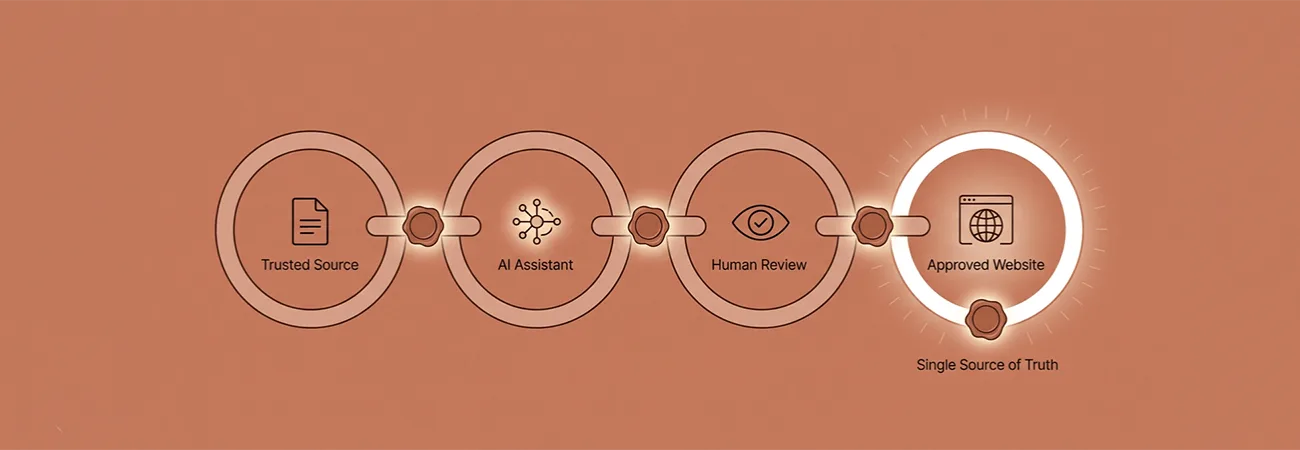
The model does not invent the personalized copy. Content owners write the approved variants for each segment and store them in the same place as the default page. The system selects which variant to show based on the rules the content team set. When the model is used at all, it is used to draft a variant from the approved source page and a short brief that says which audience the variant is for. The draft goes through the same review as any other content change before it is allowed to appear.
This keeps the number of live variants small enough that a content owner can still open them and read them. A page that has twelve dynamically assembled paragraphs is not a page the team can stand behind when a visitor complains. Three or four approved variants for a high-traffic page is usually the practical limit. Anything beyond that tends to create content debt that no one wants to maintain.
Rules are visible and reversible
Every personalization rule is written down in a place the content team can see: which segment, which page, which variant, and who approved it. The rule can be turned off without a deployment. When a program ends or a campaign finishes, the associated variant is unpublished in the same change that removes the campaign page. The selection logic does not continue to serve stale language because a developer has not yet cleaned up a configuration file.
We also log which variant was shown, without storing information that identifies the visitor beyond the segment. That log is enough to answer "why did this person see the renewal message?" without creating a permanent record of their browsing history. If the organization later needs to show that a particular statement was only shown to authenticated members, the log and the rule definition are the evidence.
Measurement stays tied to existing goals
The success of a personalized variant is measured against the same conversion or task-completion metric the default page already uses. If the "new patient" variant increases form starts but also increases calls to the wrong department, the content team sees both numbers. We do not treat an increase in time on page as success when the page's purpose is to send the visitor to a form or a phone number.
When a variant underperforms, the response is to review the approved copy, not to ask the model for a new version on the fly. On-the-fly generation removes the editorial gate that made the approach acceptable in the first place. The model can be used again to draft a replacement, but the replacement still goes through review before it replaces the underperforming one.
What marketing teams actually use
The implementations that stay in use share a few characteristics. The segments are ones the organization already understands. The variants are written and approved by the same people who own the rest of the site. The selection rules can be turned off by a content editor. And the measurement is reported in the same dashboard the team already checks for form completions or document downloads.
Personalization that requires a new tracking platform, a consent redesign, and a promise that the model will only say things the content team would have said is usually the version that never leaves the pilot. The version that starts with the pages and audiences the team already manages tends to be the one they keep.