Discover how AI can accelerate website design without replacing the human judgment behind it. This post walks through how we use AI to turn client conversations, design references, and conversion goals into faster prototypes while keeping strategy and creative decisions firmly in human hands.
There's a lot of noise right now about AI "designing websites." Most of it oversimplifies what's actually happening. After building this workflow into our own delivery process, here's what we've found to be true: the AI isn't doing the design work. It's doing the mechanical work that used to stand between a good brief and a good prototype, and that distinction changes how you should think about using it.
Here's the process, step by step.
It starts with a conversation, not a prompt
Every project begins the same way: a conversation with the client about what the site needs to accomplish, what's wrong with the current one, and what direction they want to take it. Nothing about that changes because AI is involved later.
What does change is what happens right after. Instead of spending an hour transcribing notes from that conversation, we feed the recording or transcript directly into Claude and ask it to distill everything discussed, goals, tone, must-haves, into a structured design brief. That one step doesn't just save time; it forces clarity. Writing a brief thorough enough for an AI to act on means writing a brief thorough enough for anyone to act on: brand assets, audience, positioning, existing content, competitive context. All of it has to be explicit, because nothing gets filled in by osmosis the way it might in a hallway conversation with a design team.
Borrowing what works, deliberately
Clients almost always have reference points: competitor sites, sites in an adjacent industry, something they saw and liked. Rather than eyeballing what makes those references work, we ask AI to study them and distill the underlying patterns into a reusable set of design rules: navigation structure, color discipline, layout rhythm, the works.
The output is a strong starting point, but never gospel. It might recommend a color direction or an imagery style that doesn't actually fit the client's brand or audience, and when that happens, we correct it. This is the part of the process that's easiest to get wrong if you skip it: AI is genuinely good at pattern recognition across reference material, but it has no idea what a specific client's stakeholders will actually approve. That judgment call still belongs to a human, every time.
Conversion is the whole point
It's easy to treat a homepage redesign as a purely visual exercise, and that's a mistake. A B2B homepage has exactly one job: turning a visitor into a lead. Not looking impressive. Not winning a design award. Converting.
So before anything gets generated, we build a third document: a conversion-optimization guide grounded in established CRO frameworks and tailored to the specific audience and goals of the project. Every downstream design decision, where trust signals go, how many fields the contact form has, where the calls-to-action repeat, traces back to a decision made in this document, not a stylistic whim.
Generation is the easy part
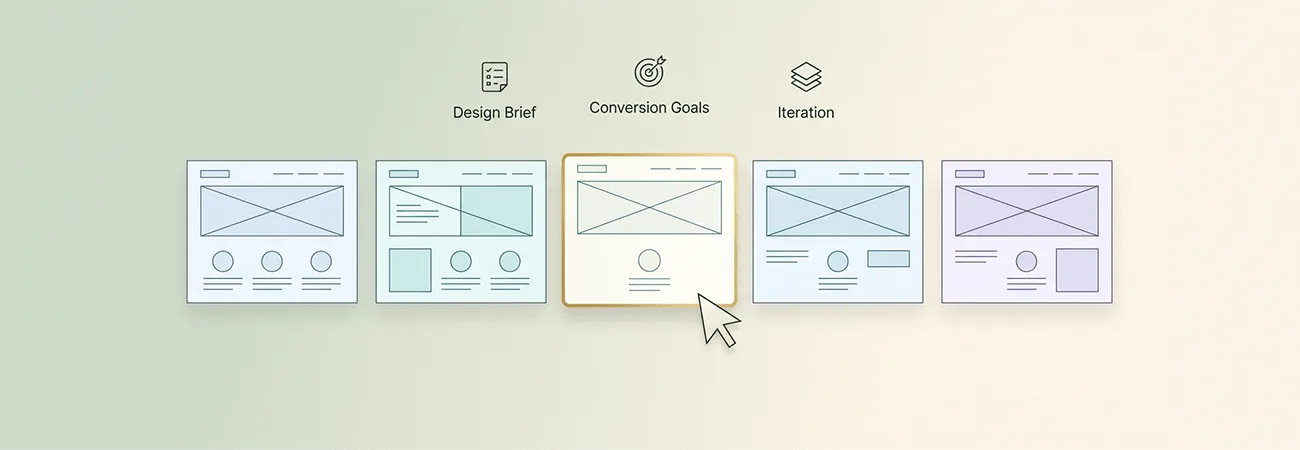
By this point, three documents are in hand:
- A design brief, distilled from the client conversation itself
- A set of design rules, drawn from references the client already responded to
- A conversion guide, translating "we want more leads" into concrete, testable structure
With all three in place, we're finally ready to generate prototypes. And this is the part that surprises people: it takes minutes.
We typically run the same three documents through more than one AI tool to see how each interprets the same instructions. The results usually share a structure, because the conversion guide dictates that structure, but differ in visual execution: one might lean into a card-based layout for a given section, another might use a more editorial layout with supporting photography. Neither is wrong. Both are legitimate creative interpretations of the same well-specified brief.
From there, the process becomes genuinely collaborative rather than one-directional. We don't have to pick a single "winner" and move on. We can take the layout structure from one concept and the color treatment from another, or ask AI to rebuild one section in the style of a different prototype entirely. It's less like choosing a finished product off a shelf and more like having several fluent first drafts to assemble from.
What we've actually learned
It would be easy to walk away from this thinking the lesson is "AI designs websites now." That's not quite it.
The lesson is that the brief is the design. The hours spent turning a conversation into a structured document, studying reference sites into explicit rules, and translating "we want more leads" into a concrete conversion strategy: that's where the actual thinking happens. The generation step, the part that looks the most like magic, is the fastest and least consequential part of the entire process.
That's also, as it turns out, good news for anyone worried AI is coming for design judgment. It isn't. It's coming for the parts of the process that were always mechanical: transcribing, pattern-matching, first-draft generation. It's leaving the parts that require actually knowing the client exactly where they've always been: with the people who know the client.
Curious how this kind of workflow could apply to your own project? Let's talk.