Visus puts GitHub Copilot Modernization Agent to the test in a real-world .NET Framework 4.8 modernization proof of concept. Discover how AI-assisted assessment, planning, migration, and validation can accelerate modernization while keeping experienced engineers in control of critical technical decisions.
Modernizing a legacy application involves more than upgrading its framework. Years of business logic, dependencies, configuration, integrations, and architectural decisions can make the process complex and time-consuming.
Visus conducted a proof of concept (POC) using an existing enterprise application built on .NET Framework 4.8 to evaluate how AI-assisted development could help streamline application modernization while keeping engineers in control of critical technical decisions.
The Challenge
The application had been maintained and enhanced over several years and contained established business logic, third-party dependencies, configuration, and integrations.
Running on .NET Framework 4.8 limited the application's ability to take advantage of the modern .NET ecosystem, current development practices, cloud deployment options, and ongoing platform improvements.
A successful migration required more than changing the target framework. Engineers needed to understand the existing solution, analyze dependencies, identify compatibility issues, update application code and configuration, resolve unsupported APIs and packages, and repeatedly build and test the application.
Visus wanted to determine whether AI-assisted modernization could reduce this manual effort while maintaining the engineering oversight required for an enterprise application.
The Approach
Visus used GitHub Copilot Modernization Agent, Modernize CLI, GitHub Copilot, and other AI-assisted development capabilities as part of a structured modernization workflow.
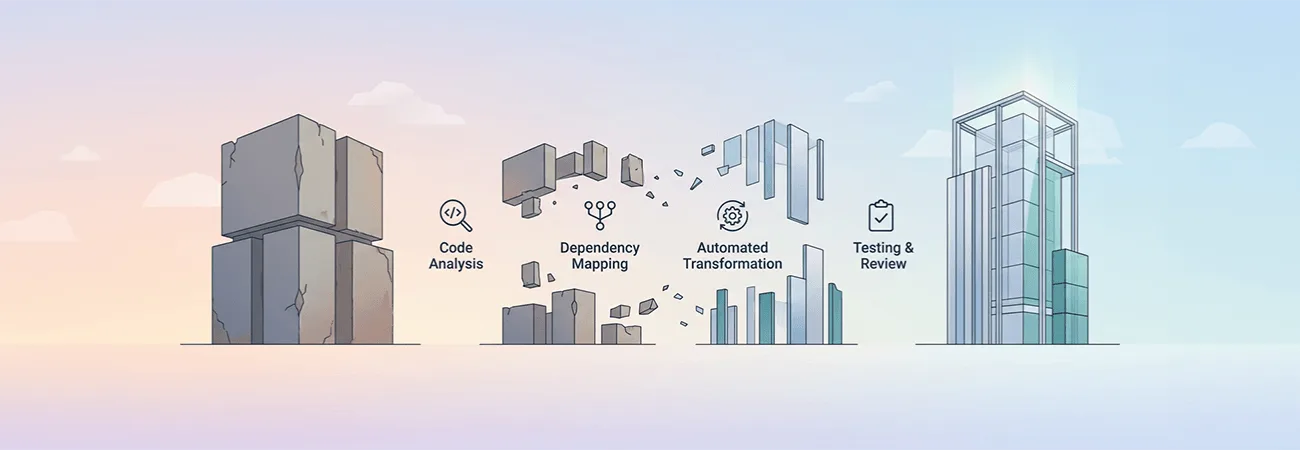
The process followed four stages:
Assess
The modernization tooling analyzed the existing .NET Framework 4.8 application to understand its structure, dependencies, configuration, compatibility concerns, and potential modernization opportunities.
This provided engineers with an AI-assisted starting point for understanding the application and identifying areas that required attention.
Plan
The assessment informed an ordered modernization plan.
Visus engineers reviewed the recommendations before implementation to ensure they aligned with the application's architecture, business requirements, and target platform.
This human review remained critical. AI could accelerate analysis and planning, but engineers were responsible for approving the technical direction.
Modernize
The tools assisted with migration activities such as updating project structures, upgrading dependencies, replacing incompatible APIs, modifying configuration, resolving build issues, and generating or modifying application code.
Rather than attempting to automate the entire migration in one operation, Visus followed an iterative approach. Engineers implemented changes incrementally, compiled the application, reviewed the results, and addressed issues before moving forward.
Validate
After significant changes, engineers validated the application through builds, automated tests where available, code review, security and dependency checks, and functional testing.
AI-assisted tools helped investigate build failures and compatibility issues and proposed potential fixes. Engineers reviewed those changes before accepting them.
The resulting workflow was:
Existing Application → AI-Assisted Assessment → Modernization Plan → Engineering Review → AI-Assisted Migration → Build & Test → Validation → Modernized Application
The Results
The POC demonstrated how AI-assisted tools can support a structured application modernization process.
The tools helped accelerate several activities, including:
- Application discovery and dependency analysis
- Modernization planning
- Code transformation
- Compatibility issue identification
- Build troubleshooting
- Repetitive development tasks
The POC also helped Visus identify where AI can provide the most value and where experienced engineering judgment remains essential.
AI can analyze codebases, identify dependencies, suggest modernization approaches, perform repetitive transformations, and help troubleshoot issues. Engineers still need to evaluate business requirements, determine the appropriate architecture, review generated changes, and validate application behavior.
Because this was a proof of concept, the primary outcome was not simply completing a framework migration. The goal was to determine whether AI-assisted modernization could become a repeatable part of the Visus application modernization process.
The POC also established a foundation for measuring future modernization engagements using metrics such as assessment time, migration effort, compatibility issues identified, AI-assisted tasks completed, manual corrections required, build and test success, and overall time to a deployable modernized application.
Key Takeaway
The POC reinforced a simple principle: AI can accelerate application modernization, but successful modernization still requires a structured engineering process.
AI provides speed and scale. It can analyze large codebases, surface dependencies, generate migration plans, perform repetitive transformations, and assist with troubleshooting.
Experienced engineers provide judgment. They determine the appropriate architecture, evaluate AI recommendations against business requirements, review generated changes, and validate the final application.
For Visus, the opportunity goes beyond using AI to write migration code faster. By combining AI-assisted tools with engineering standards, architectural patterns, reusable AI skills, automated testing, and human review, modernization can become more efficient, consistent, and scalable.
The POC provided a practical foundation for that approach, showing how AI can become an accelerator across the modernization lifecycle, from assessment and planning through implementation and validation.