
AI Is Only as Good
as the Data Behind It.
Before you ask AI to answer questions, make recommendations, or take action, make sure it is working with data you can trust. Visus helps organizations bring fragmented data together, improve its quality and consistency, and create a trusted data foundation for reporting, analytics, AI assistants, and future AI applications.








 Microsoft Fabric
 Power BI
 Microsoft Azure
 Microsoft Foundry
AI doesn't fix bad data
Organizations are moving quickly to find practical uses for AI. But many discover that the biggest obstacle is not the AI itself. It is the data underneath it.
Customer information may be spread across CRM, ERP, billing, operational applications, databases, spreadsheets, and other systems. The same customer may appear differently in several places. Important fields may be incomplete. Definitions may vary between departments. Different reports may produce different answers to the same question.
AI can make it easier to interact with business data, but it cannot make unreliable underlying data trustworthy on its own. Inconsistent or inaccurate data can undermine the quality of AI-generated answers and actions.

The warning signs often show
up before your first AI project
Your data may need attention if:
Four capabilities.
One trusted foundation for data and AI.
Bring Disconnected Data Together
Visus brings relevant structured data together into a centralized foundation without requiring you to replace the applications and systems that run your business.
Depending on the objective, this may be a focused repository supporting a specific AI application or a broader enterprise data platform.
- Connect relevant CRM, ERP, operational, database, and other structured data sources
- Reduce dependence on manual data consolidation
- Make important information easier to access
- Create a foundation reporting and AI applications can consistently use
AI Needs Data You Can Depend On
Moving data into one place does not automatically make it trustworthy.
Visus helps identify and address duplicates, incomplete information, inconsistent values, conflicting definitions, and other data-quality issues that can undermine reporting, analytics, and AI.
Data quality is not a one-time cleanup. We also consider how data enters and moves through the environment so the organization can maintain confidence in it over time.
Create One View of the Business
A single source of truth requires more than putting information in a central repository.
If the same customer appears differently across CRM, ERP, billing, and other systems, those records may need to be matched, reconciled, and standardized before the organization has a true unified view.
Visus helps create trusted views of important business entities, such as customers, so employees, reports, and AI applications can work from consistent information.
Put Trusted Data to Work
Once the right data is connected, cleansed, reconciled, and accessible, the organization can begin using it in new ways.
That foundation can support traditional reporting and analytics as well as AI-powered experiences. For example, an AI Reporting Assistant can allow employees to ask questions of trusted business data using natural language.
- Support trusted reporting and analytics
- Enable natural-language access to business data
- Prepare data for AI assistants and agentic applications
- Create a scalable foundation for future AI use cases
You do not need perfect data to start
Before investing in your next AI initiative, understand whether the data that matters to that initiative can support it.
Visus can help you identify gaps in data quality, accessibility, integration, and architecture and create a practical path toward a trusted, AI-ready data foundation.
You do not need to clean every database, replace every application, or solve every data issue across the enterprise. Start with a meaningful business objective and the data required to support it.

A practical example of what data readiness can enable
Imagine an organization where customer information is spread across multiple systems. Employees need to search in several places to understand the customer, records do not always align, and producing a complete picture requires manual effort.
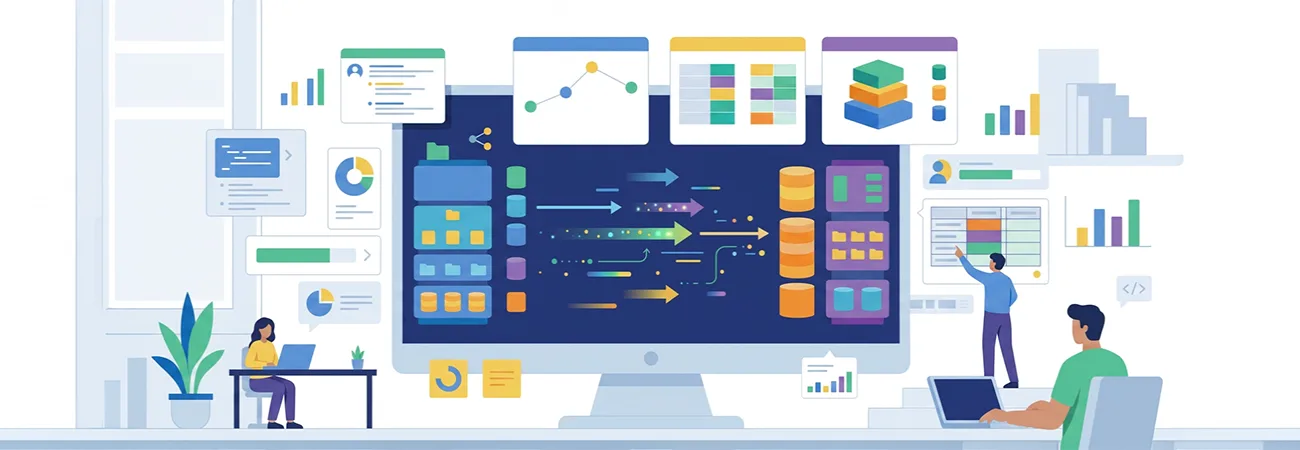
Visus can bring those disparate data sources together into a centralized foundation, reconcile customer information, and create a trusted view of each customer.
That immediately creates value. Employees can find information more easily, reporting can draw from more consistent data, and teams can make decisions with greater confidence.
It also creates the foundation for AI. With trusted data in place, an AI Reporting Assistant can allow employees to ask business questions using natural language and receive answers based on the organization's centralized data.
The visible AI experience may feel simple. The trusted data foundation underneath it is what makes the experience useful.
Start with the business objective,
then prepare the data it requires
Your entire enterprise data estate does not need to be perfect before you can begin using AI.
Understand the Data Behind the Business Objective
We begin by understanding the reporting, analytics, or AI outcome the organization wants to achieve. Then we examine the relevant data: where it lives, how accessible it is, whether it is sufficiently accurate and consistent, how records relate across systems, and what issues could undermine the desired outcome.
Turn Disparate Data Into Trusted Data
Visus connects relevant sources, cleanses and standardizes information, reconciles important records, and establishes a centralized data foundation. For a focused AI application, the right solution may be a purpose-built central data repository. For organizations with broader data, analytics, and AI ambitions, the path may lead to an enterprise data platform such as Microsoft Fabric.
Use the Foundation Today and Build on It Tomorrow
Once trusted data is available, it can immediately improve reporting, analytics, and access to business information. From there, Visus can help enable AI-powered capabilities such as natural-language querying, AI Reporting Assistants, and other AI applications. As needs grow, the foundation can expand to additional data sources, use cases, reporting capabilities, and AI solutions.
From trusted data to reporting, analytics, and AI
AI may be changing how organizations interact with data, but the fundamentals of dependable data have not changed.
Visus has been delivering Data & Analytics solutions for more than three decades. We bring experience in data architecture, integration, cleansing, warehousing, reporting, and analytics together with modern AI expertise.
That combination matters because we understand both sides of the equation: how to build a trustworthy data foundation and how that data will ultimately be consumed by reporting, analytics, AI assistants, and agentic solutions.
For organizations invested in Microsoft, Visus can work across technologies including Microsoft Fabric, Azure, Power BI, and Microsoft Foundry.
Visus is a Microsoft Solutions Partner with designations spanning Data & AI (Azure), Digital & App Innovation (Azure), and Infrastructure (Azure).
For organizations that need a broader enterprise data platform, Visus can help establish or modernize the data foundation using Microsoft Fabric.

Better data creates value before
the first AI application goes live
One Trusted View
Bring together and reconcile information across relevant systems so employees, reporting tools, and AI applications work from consistent data.
Greater Confidence
Improve accuracy, consistency, and reliability so people can spend less time questioning the numbers and more time acting on them.
Faster Access to Answers
Make trusted information easier to find, report on, analyze, and ultimately query using natural language.
Foundation for AI
Prepare accurate, accessible, integrated data to support AI assistants, agentic solutions, analytics, and future AI use cases.
Client success stories

Process Automation and Data Integration
Visus automated Nationwide Medical's manual order processes and integrated its disconnected systems, cutting hours of labor and eliminating costly data errors.
View Success Story →Business Intelligence
Visus built Chumash Casino Resort a metadata-driven data warehouse and ETL foundation the resort fully owns, extending business intelligence across every area of the enterprise.
View Success Story →Reporting and Performance Management Application - RPM.net
Visus replaced a complex, packaged performance management system with a custom .NET application, making it faster and easier for Santa Barbara County staff to track KPIs and build the Budget Book.
View Success Story →
Start with the data
that matters most
You do not need to fix every data problem before pursuing AI. Bring us the business questions you want to answer, the reporting you struggle to trust, or the AI opportunity you want to explore. We'll help determine whether the underlying data is ready and what needs to happen if it isn't.
Let's Talk