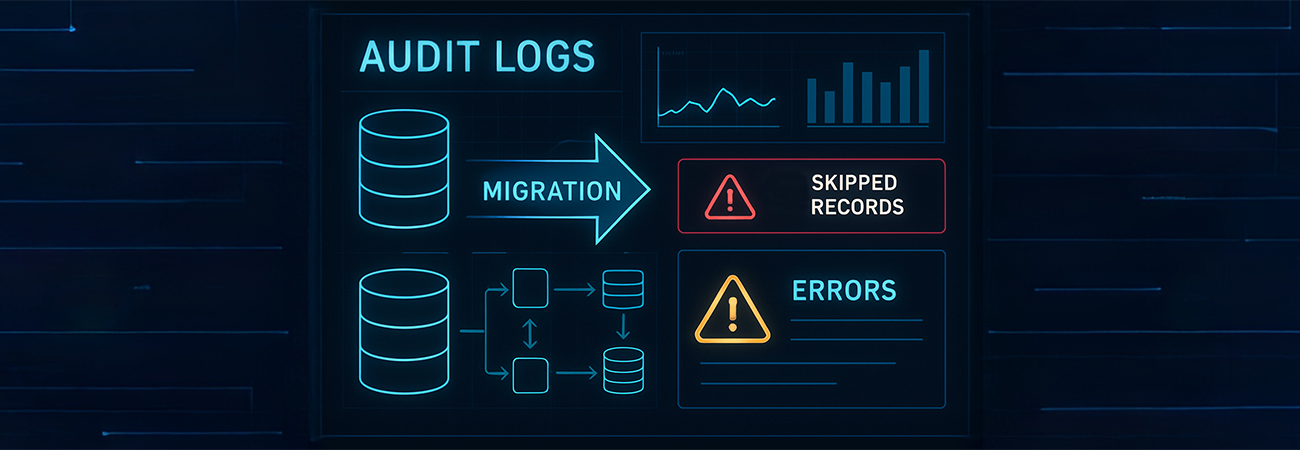
Data migration projects often come with hidden complexity—especially when assumptions, evolving source data, and shifting testing timelines collide. For one client undergoing a significant database conversion, this complexity became a recurring challenge. Despite several rounds of migration testing, expected data records were frequently missing, and tracing the root cause of each issue was time-consuming and inefficient. End users repeatedly asked the same question: Why didn't this data come over?
To streamline the process and eliminate guesswork, a custom Data Conversion Audit Log was developed. This solution provided a systematic way to track and explain data migration results in real time.
The audit log was powered by a custom SQL table and a series of targeted procedures. These procedures analyzed how datasets were joined—flagging mismatches caused by inner joins, null foreign keys, or filtering logic that excluded valid records. For example, if an employee record failed to migrate because a required location ID was missing, the audit log generated a message such as:
“Record for Employee John Doe was not exported due to foreign key field locationID being null. Employees must have a valid address to be converted.”
Each audit entry included the procedure name, data table, field, audit check number, and a human-readable explanation of the issue. A master procedure ran all checks automatically after every migration test, enabling quick verification of the design, logic, and underlying assumptions.
This approach delivered significant value:
- Common issues were identified before users reported them.
- Duplicate research efforts were eliminated.
- New issues could be captured once and monitored across future tests.
- Audit coverage improved with every iteration.
One key lesson stood out: investing early in automated audit procedures pays off throughout the project lifecycle. Rather than chasing individual issues reactively, the client gained a proactive, repeatable process that ensured every data migration test was more reliable than the last.
Looking to reduce friction and improve confidence in your own data conversion efforts? A well-designed audit log may be the missing piece.