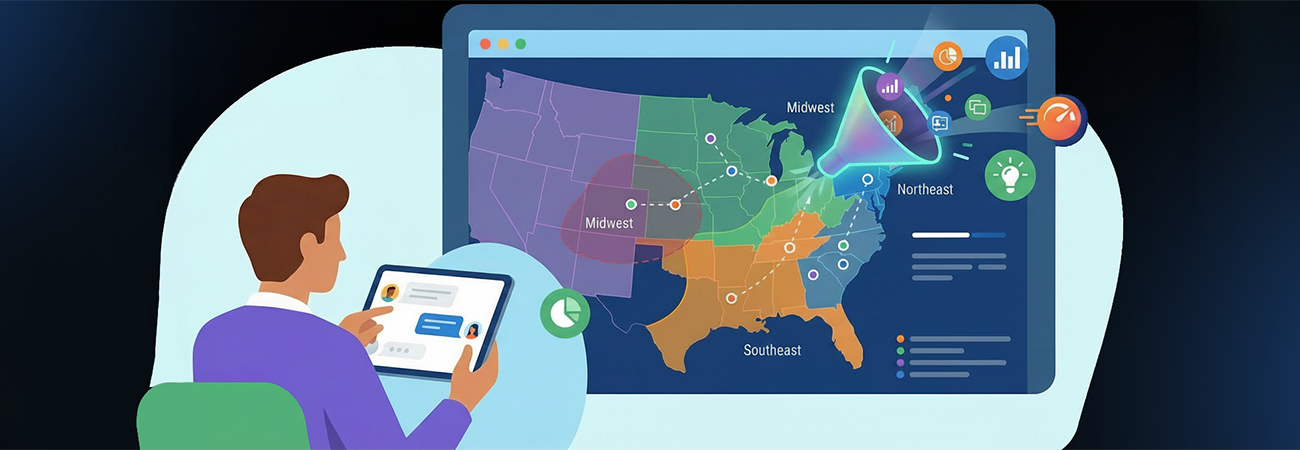
Global organizations managing extensive sales networks face a deceptively simple problem: customers struggle to identify the correct sales representative for their region or institution. In one case, a publishing organization with a worldwide footprint had sales rep information scattered across multiple public-facing pages, inconsistently structured and designed for human readers—not machines. This made manual searches tedious, burdened support teams with repetitive inquiries, and prevented reliable chatbot or search functionality.
The challenge wasn't extracting text—it was extracting meaning. The source content contained mixed headings, paragraphs, lists, emails, and links, expressed in multiple ways across regions and countries, and changing without notice. Traditional scraping or rule-based approaches would have been brittle, costly, and prone to errors.
Visus implemented an AI-driven data extraction pipeline that interprets content semantically. AI identifies sections, labels, territories, and contacts while normalizing country names, emails, and URLs. Ambiguous or duplicate data is resolved, producing a deterministic, versioned JSON structure designed to power the FindMyRep chatbot. Multiple sources are merged into a single authoritative dataset while preserving provenance for traceability.
The result is a reliable single source of truth for sales territory data. The organization can now onboard new or updated sources quickly, maintain data with minimal manual effort, and confidently power chatbots and search tools. Customers can accurately identify their sales representatives, and teams no longer rely on fragile, error-prone workflows.
Key takeaway: AI excels when used as a data engineering assistant, not just a conversational interface. By pairing semantic understanding with strict output contracts, organizations can unlock legacy content, transforming messy, human-oriented data into production-ready knowledge systems.