Introduction
Retrieval-Augmented Generation (RAG) has become one of the most popular approaches for building enterprise AI applications. By combining large language models with organizational knowledge, RAG helps AI generate responses grounded in trusted information rather than relying solely on its training data.
For many organizations, RAG is an excellent starting point.
However, as AI initiatives mature, teams often discover that vector search alone cannot solve every business problem.
Some questions require real-time data. Others require executing business logic, interacting with APIs, or completing workflows that extend far beyond document retrieval.
Understanding where RAG ends—and where broader AI architectures begin—is essential for building enterprise-ready solutions.
What RAG Does Well
RAG excels at answering questions from unstructured content.
Examples include:
- Employee handbooks
- Technical documentation
- Knowledge bases
- Policies and procedures
- Product manuals
Instead of relying on potentially outdated training data, AI retrieves relevant information before generating a response.
This improves both accuracy and transparency.
Where RAG Begins to Struggle
Not every business question can be answered from documents.
Examples include:
- "How many invoices are overdue today?"
- "Is customer ABC eligible for renewal pricing?"
- "Create a support ticket and notify the account manager."
These require current business data and actions—not document retrieval.
Real-Time Data Matters
Many business decisions depend on information that changes constantly.
Examples include:
- Inventory levels
- Customer account status
- Financial transactions
- Sales opportunities
- Service requests
AI must connect directly to operational systems rather than relying on indexed documents.
AI Needs Business Logic
Organizations frequently assume AI should "know" company policies.
In reality, many decisions depend on structured business rules.
For example:
- If customer is Gold tier
- AND contract is active
- AND invoice balance is under $5,000
- Offer expedited replacement.
Business logic belongs in applications—not prompts.
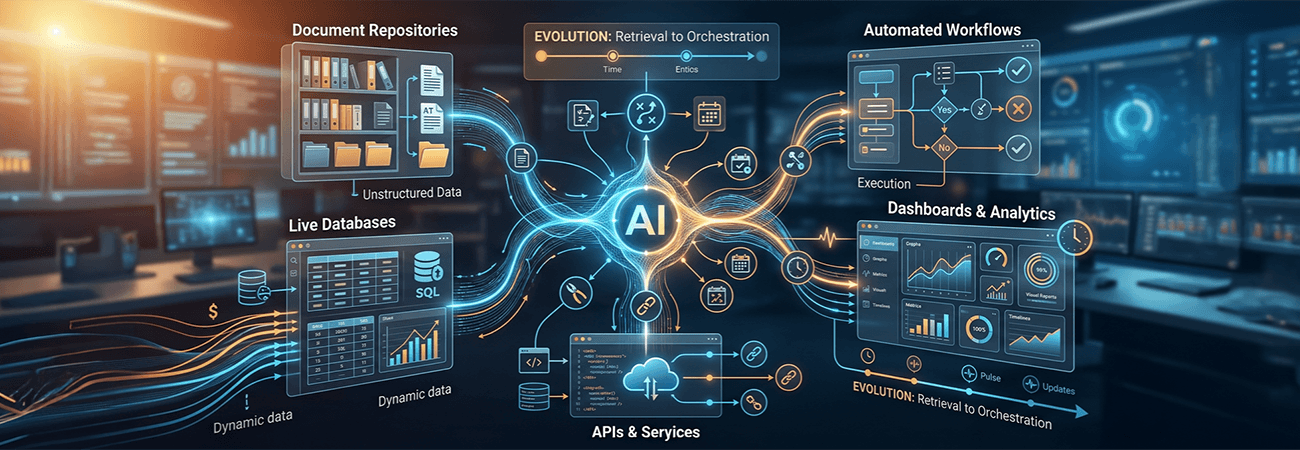
The Role of APIs
Enterprise AI becomes significantly more powerful when it can:
- Query databases
- Call REST APIs
- Create CRM records
- Generate reports
- Trigger workflows
At this point, AI becomes an orchestrator rather than simply a search interface.
Moving Toward Agentic Systems
Modern AI agents combine:
- Retrieval
- APIs
- Memory
- Planning
- Tool usage
- Decision support
Rather than answering questions alone, they can complete multi-step business processes.
Conclusion
RAG remains a foundational technology for enterprise AI, but it is only one piece of a larger architecture. Organizations that combine retrieval, structured data, APIs, and business logic create AI solutions that move beyond answering questions to actively supporting business operations.