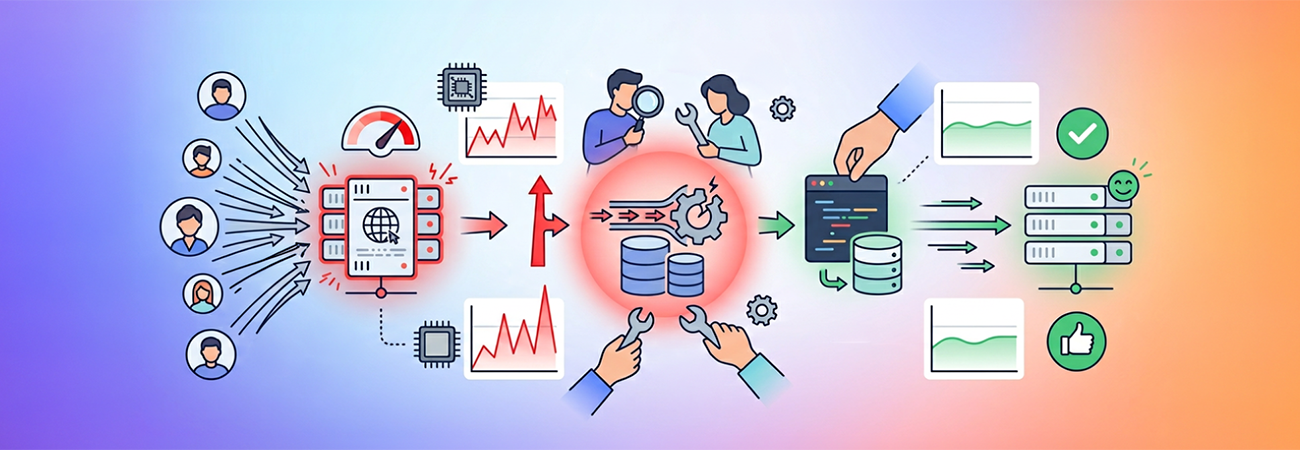
A production issue with severe consequences can often be traced back to something deceptively small. For one organization, memory spikes in a Sitefinity 15.3 application led to slow response times, excessive error logs, and eventually, application pool failures. The application, running on the .NET Framework, regularly hit 100% memory usage under traffic load. What made the situation particularly difficult to address was the inability to reproduce the issue in a development environment.
The challenge was clear: identify and resolve the memory issue—without access to the exact production behavior.
To bridge that gap, Visus employed K6, a powerful load testing tool, to simulate real-world traffic patterns. Custom scripts were developed to trigger workflows suspected of contributing to high memory usage. Through methodical testing, it became evident that the issue extended beyond a suspected sync process. Certain sections of the site were consuming excessive server memory, indirectly interfering with sync operations and degrading overall application performance.
This discovery highlighted the importance of mimicking real user behavior during load testing. By replicating actual site usage patterns, the development team was able to observe memory pressure in a controlled environment—revealing issues that traditional testing had missed.
Key Takeaways
- Proactive load testing must become a standard part of QA—not just a reaction to performance problems.
- Realistic traffic simulation is essential to uncover resource bottlenecks and hidden inefficiencies.
- Scriptable load tools like K6 offer flexibility and precision for performance testing at scale.
- Memory profiling and monitoring are indispensable for diagnosing issues under load.
- Early detection saves costs. Catching performance issues during development avoids costly fixes and downtime in production.
By applying smart load testing strategies and leveraging modern tools, it's possible to turn elusive production problems into solvable development challenges—before they escalate.