Maintaining clean, readable, and reusable CSS becomes increasingly challenging as user interfaces grow in complexity. Deeply nested elements often lead to repetitive and lengthy selectors that increase the risk of inconsistencies and complicate future updates. Managing style specificity—especially when overriding styles across components—can add unnecessary complexity.
A common example involves applying consistent styling to multiple heading levels. Traditional CSS requires repeating selectors like:
h1,
h2,
h3,
h4 {
color: blue;
font-weight: bold;
}
This approach, while straightforward, can clutter stylesheets and increase maintenance overhead.
Visus LLC introduced a streamlined solution by leveraging the CSS pseudo-classes :is() and :where() to simplify and consolidate selectors. The :is() selector groups multiple elements under a single rule while preserving specificity, reducing repetition:
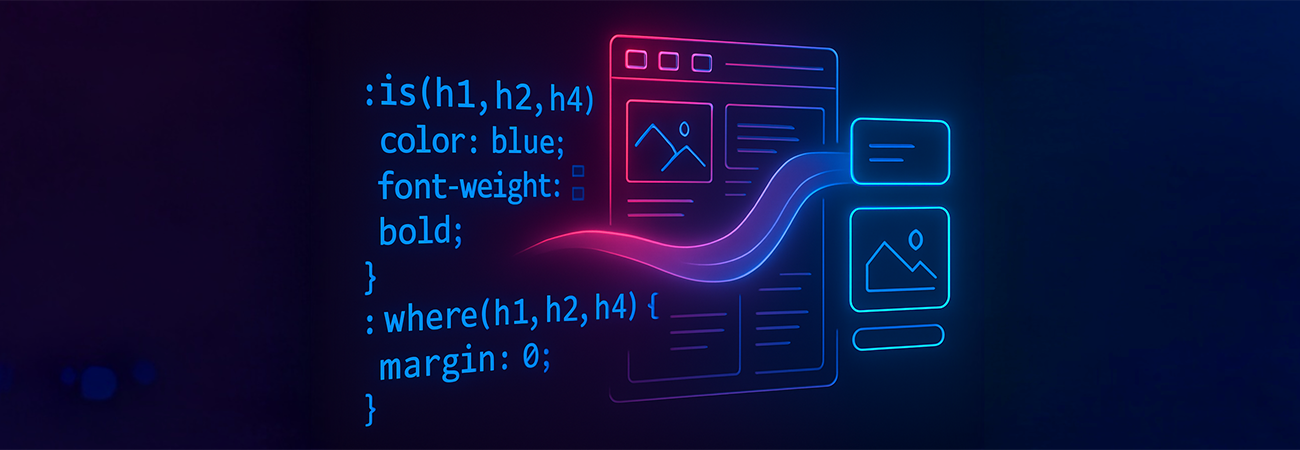
:is(h1, h2, h3, h4) {
color: blue;
font-weight: bold;
}
This concise syntax improves readability without sacrificing control.
For base styles or low-priority resets, :where() offers a powerful advantage. It applies styles without increasing specificity, making overrides more manageable later in the cascade:
:where(h1, h2, h3, h4) {
margin: 0;
}
This approach defines foundational styles while ensuring that component-specific rules can take precedence when necessary.
The key takeaway from this approach is that :is() reduces code repetition but requires thoughtful management of specificity inheritance. Meanwhile, :where() excels in establishing baseline styles that can be easily overridden. Together, these selectors enhance scalability and flexibility in complex stylesheets while maintaining clear control over style conflicts.
By adopting these modern CSS features, Visus, LLC helped the client reduce complexity and improve maintainability of their UI styles—delivering a cleaner, more scalable front-end architecture.