Organizations rely on modern web platforms to support critical operations, customer engagement, and digital growth. Yet even when teams understand their website’s technology stack, a more important question often remains unanswered:
Are we exposed to risk right now—and how serious is it?
For many enterprise teams, the answer is buried in release notes, version histories, and fragmented vulnerability data. Translating that information into clear, actionable insight requires more than visibility. It requires interpretation.
An internal product initiative set out to solve a growing problem faced by enterprise organizations across industries, including higher education, healthcare, and manufacturing. Marketing teams, engineers, security stakeholders, and pre-sales architects all needed a reliable way to assess website risk—quickly and consistently.
Despite having access to version data, teams struggled to determine real exposure. Release notes were lengthy and difficult to interpret. Vulnerabilities (CVEs) were distributed across multiple versions. It remained unclear which issues applied to the current environment. Teams could not easily answer a simple but critical question: what risks affect us right now?
The gap was not a lack of data. It was a lack of clarity.
At first glance, identifying risk might seem straightforward—detect the technology, check the version, and compare it to the latest release. In practice, the problem is far more nuanced.
Release histories often include hundreds of entries spanning multiple versions. Within those entries, teams must distinguish between security fixes, general improvements, and breaking changes. Vulnerabilities frequently appear across multiple releases, and not all changes are relevant to every environment. Determining risk requires mapping a specific version to everything that has changed since—and identifying what has not yet been addressed.
This is not just a data challenge. It is a reasoning challenge.
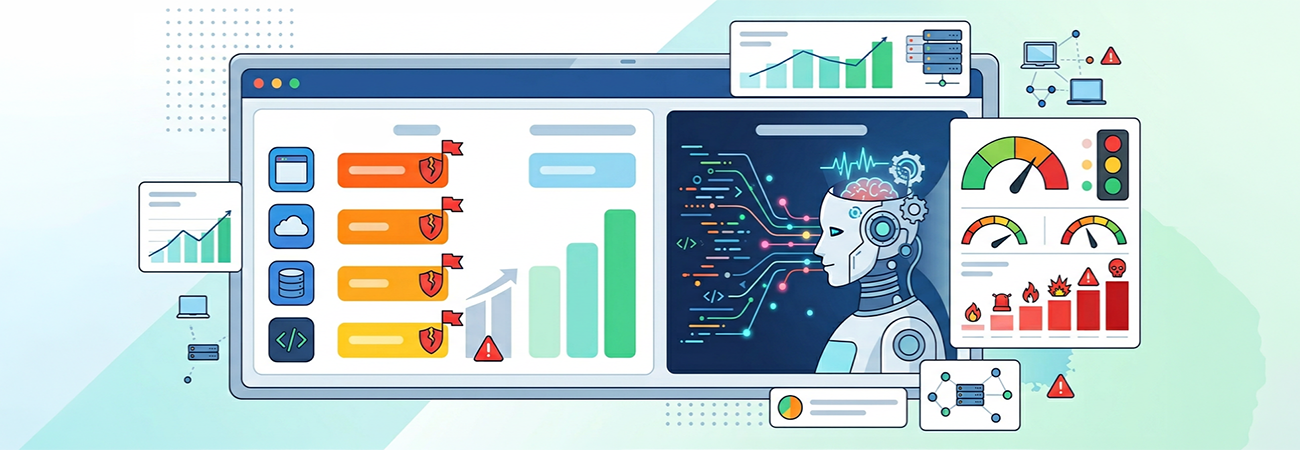
To address this, Visus developed an AI-powered Technology Intelligence engine designed to transform raw release data into decision-ready insights.
The solution begins by structuring release information into versioned JSON catalogs, enabling consistent analysis across platforms. The system then computes upgrade-path intelligence by comparing the detected version against the latest available version to identify what is missing.
It extracts and organizes key security information, including CVEs impacting the current version, security fixes introduced in subsequent releases, and platform hardening improvements.
Using Azure OpenAI, the system generates a risk-first summary that prioritizes current exposure over future enhancements. Each insight is persisted for performance and consistency, ensuring repeatable results across use cases.
The final output delivers a dual-layer experience: a clear, AI-generated executive summary paired with detailed technical evidence that supports the findings. The system transforms complex release data into actionable security insight.
The implementation fundamentally changed how teams assess website risk.
What once required hours of manual review is now available instantly. Teams gain immediate visibility into current vulnerability exposure, a clear understanding of applicable risks and their severity, and insight into which upgrades resolve specific issues. The solution eliminates the need to manually parse release notes and allows teams to focus on remediation and strategy instead of interpretation.
Release notes document change, but they do not communicate risk.
True risk lies in the gap between a current version and what has been fixed since. Understanding that gap requires more than aggregation. It requires context.
AI delivers the most value when it is grounded in structured data, focused on current exposure, and capable of translating complexity into a clear, actionable narrative.
Most tools stop at identifying technologies. The real value begins when organizations understand what those technologies mean for security—and what actions they need to take next.