A mid-sized organization relied on a complex internal platform to manage operations and user interactions. Over time, the system expanded to support critical business functions, but it depended heavily on manual processes and fragmented tools. As workflows became more disconnected, teams spent more time coordinating tasks than delivering meaningful outcomes.
This challenge is increasingly common across enterprise environments—and it highlights why frameworks like the Microsoft Agent Framework are gaining attention.
The client faced persistent inefficiencies driven by repetitive, manual processes that spanned multiple systems. Tasks required human intervention at nearly every step, slowing execution and increasing the risk of errors. While individual tools performed their roles, they lacked coordination. The issue was not simply a lack of automation. It was a lack of orchestration. Modern enterprise systems must do more than execute isolated tasks. They must enable systems to communicate, make decisions, and act—sometimes in sequence, sometimes in parallel. Without this level of coordination, even well-built platforms struggle to scale.
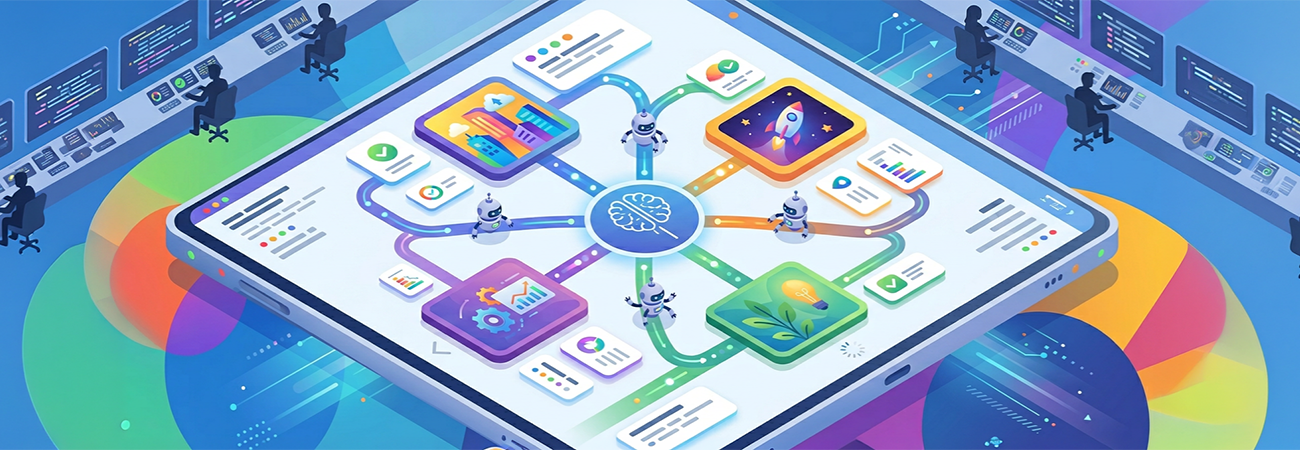
AI agents represent a shift in how work gets done. Instead of relying on static workflows, agent-based systems can dynamically respond to inputs, trigger actions, and collaborate across services. The Microsoft Agent Framework is designed to support this model, enabling multi-agent orchestration and intelligent decision-making across enterprise environments. However, most systems are not architected to support this level of intelligence. In this case, the client’s platform lacked the structural foundation required for AI-driven workflows. APIs were inconsistent, data flows were fragmented, and system dependencies created bottlenecks. Introducing AI agents into this environment without first addressing these issues would have amplified inefficiencies rather than resolved them.
Visus approached the problem by focusing on the system’s architecture rather than forcing immediate automation. The solution centered on preparing the platform for AI adoption by strengthening and standardizing APIs to improve system interoperability, organizing and streamlining data flows to ensure consistency and accessibility, reducing tight system dependencies to enable more flexible interactions, and introducing architectural patterns aligned with agent-based orchestration. These changes created a foundation that aligns with frameworks like the Microsoft Agent Framework, making it possible to layer in intelligent automation without requiring a full system rebuild.
Following these improvements, the client’s platform became more modular, predictable, and scalable. Workflows that previously required manual coordination now operate with greater efficiency and consistency. Teams spend less time managing processes and more time focusing on strategic work. Most importantly, the organization is now positioned to adopt AI agents as the next step in its evolution. With the right foundation in place, the transition to intelligent, orchestrated systems becomes significantly more practical and impactful.
AI agents are not a plug-and-play solution. Their success depends on the systems they operate within. Frameworks like the Microsoft Agent Framework unlock powerful capabilities, but only when supported by clean data structures, reliable APIs, and well-defined workflows. Organizations that invest in these foundational elements today will be better equipped to scale automation, improve decision-making, and realize the full value of AI. Enterprise leaders often focus on selecting the right tools. Long-term success depends on building systems that are ready to use them.