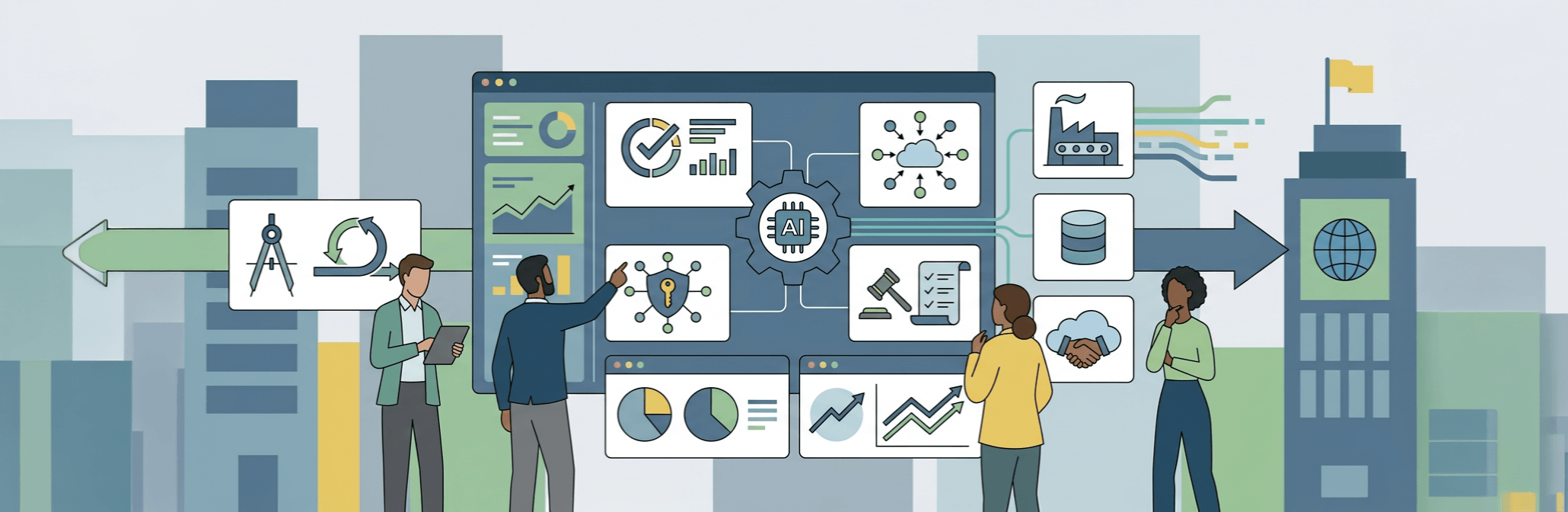
Organizations across industries are investing heavily in artificial intelligence to improve efficiency, automate processes, and enhance decision-making. While many AI proofs of concept (POCs) show promise, many never reach production.
The issue is rarely the AI technology itself. More often, organizations underestimate the complexity of deploying AI in a real business environment.
The Gap Between Demo and Production
A successful demo does not guarantee successful deployment. Production environments require organizations to address security, governance, integration, scalability, compliance, and user adoption.
Without proper planning, even impressive prototypes can stall.
Common Reasons AI POCs Fail
1. Poor Data Quality
AI systems rely on accurate and accessible data. Outdated documentation, duplicate records, inconsistent formats, and siloed systems can significantly reduce effectiveness.
Example: A client implements an AI-powered knowledge assistant, but employees receive outdated answers because company policies are stored across multiple systems and have not been updated consistently.
2. Unclear Business Objectives
Successful AI initiatives start with a defined business problem, not simply a desire to use AI. Clear, measurable goals make it possible to evaluate success and demonstrate ROI.
Example: Instead of asking, "How can we use AI?" an organization sets a goal to reduce support ticket resolution times by 30%.
3. Security and Compliance Concerns
Production AI systems often handle sensitive business information. Organizations must address data security, access controls, and regulatory requirements before deployment.
Example: A prototype works well with sample data, but deployment is delayed because the organization has not established policies governing access to customer or financial information.
4. Lack of Integration Planning
AI delivers the most value when integrated into existing business systems and workflows, such as CRM, ERP, and knowledge management platforms.
Example: An AI assistant generates accurate customer responses, but employees must manually copy and paste information because the solution is not integrated with the organization's CRM platform.
5. Unrealistic Expectations
AI is a powerful tool, but it is not a complete replacement for human expertise. Organizations achieve better outcomes when they view AI as a way to augment employees rather than fully automate every process.
Example: A document processing solution automatically extracts information, while employees review exceptions and validate critical data before final approval.
Moving AI Into Production
Organizations increase their chances of success by focusing on business outcomes, data readiness, governance, security, integration, and change management from the start.
AI initiatives succeed when treated as business transformation efforts rather than standalone technology experiments.
Conclusion
Most AI proofs of concept fail because organizations underestimate what it takes to move from prototype to production. By addressing foundational challenges early, organizations can turn promising AI initiatives into scalable solutions that deliver measurable business value.